
One Turnkey Team vs Multiple Vendors: The Real Cost of a Fragmented Fit-Out
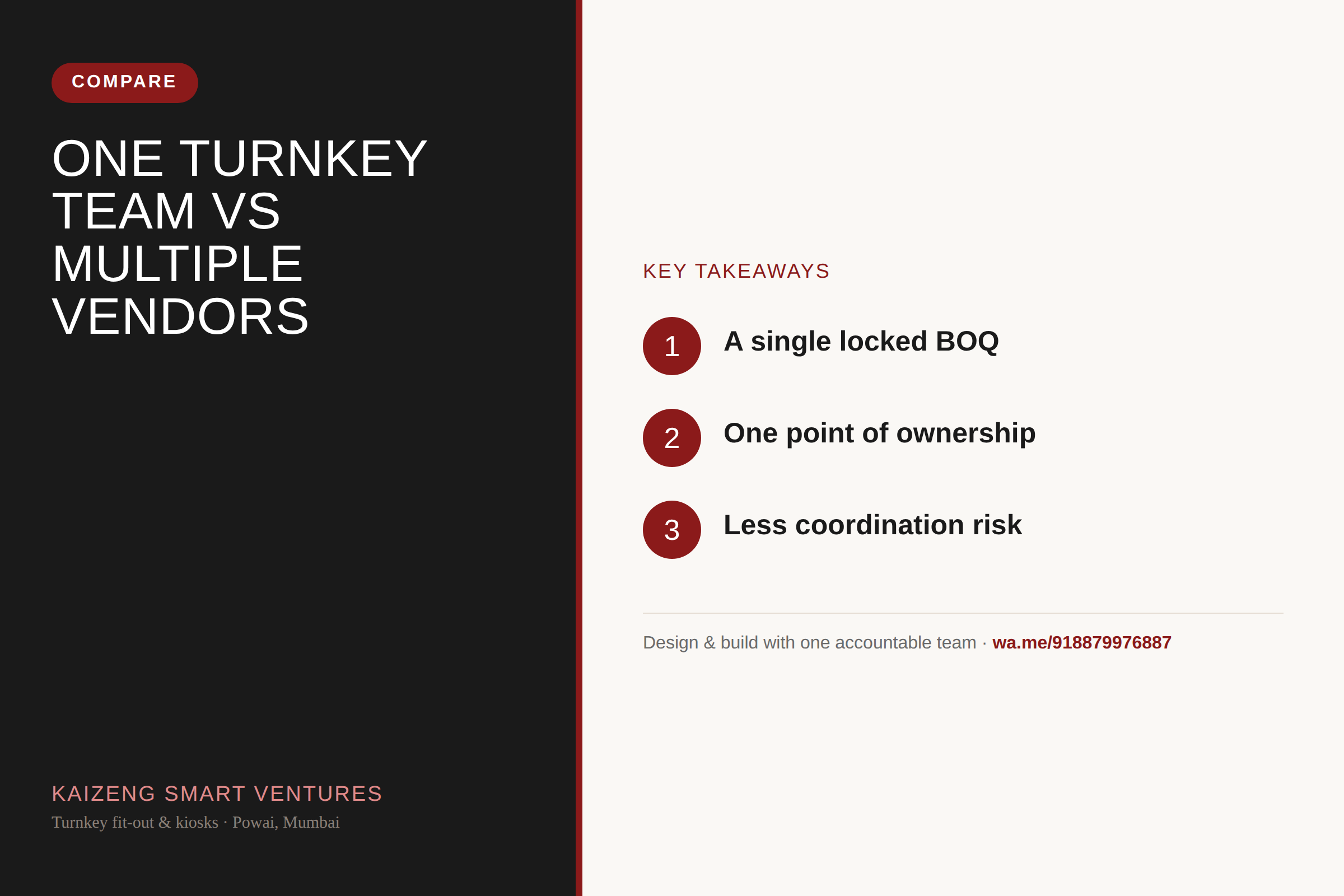
Hiring separate vendors looks cheaper line by line, but a single turnkey team is usually the safer economics once the build gets complex or the opening date is tight. The hidden cost of multiple vendors is coordination, and on a leased site that lost time costs rent with no revenue against it.
Building a cafe or store by hiring separate specialists, one for civil, one for carpentry, one for electricals, one for signage, looks cheaper on paper. Each quote is lower than a single turnkey number, so it feels like the smart move. The real cost shows up later, and it is worth understanding before you commit.
Where do fragmented builds lose money?
The hidden cost of multiple vendors is coordination, and coordination failures cost time, and time on a leased site costs rent with no revenue against it. When the electrician finishes before the carpenter is ready, or the signage vendor measures a facade the civil team later changes, someone has to catch it. On a fragmented build, that someone is usually you. Gaps between vendors are where schedules slip and where finish quality drops, because no single party owns the whole result.
Where does a single team earn its price?
A turnkey team sequences every trade against one schedule and one bill of quantities. Civil, MEP, fabrication, furniture and branding are planned together from the first drawing, so power load, drainage, counter heights and signage are locked before anyone starts cutting. If a detail changes, it changes across the whole plan at once, not in one vendor's scope while another keeps building to the old version.
How do the two approaches compare?
Upfront price: multiple vendors can look cheaper line by line, while a turnkey quote is a single, higher-looking number that already includes coordination. True cost: fragmented builds carry a real risk of delay and rework that rarely shows in the original quotes. Accountability: with many vendors, no one owns the outcome, while with one team there is a single point of ownership. Your involvement: multiple vendors need you as the project manager, while a turnkey team removes that load.
| Factor | Multiple vendors | Single turnkey team |
|---|---|---|
| Upfront price | Can look cheaper line by line | A single, higher-looking number that already includes coordination |
| True cost | Carries a real risk of delay and rework that rarely shows in the original quotes | The coordination that fragmented builds risk is already priced into the single quote |
| Accountability | No one owns the outcome | A single point of ownership |
| Your involvement | Needs you as the project manager | Removes that load |
When do multiple vendors make sense?
If your project is small and simple, you have a trusted set of tradespeople you have worked with before, and you genuinely have time to coordinate, the multi-vendor route can work and can save money. The risk rises with the complexity of the build and the tightness of your opening date.
How does Kaizeng fit?
Kaizeng runs as a single accountable team. Design and fabrication happen in our own unit in Powai, our own crew installs, and everything runs against one bill of quantities agreed before we cut anything. We are the team behind Uber's airport kiosk programme across Mumbai, Pune and Kolkata, where a fragmented build simply would not survive the install windows. If your opening date matters, a single team is usually the safer economics.
See our project management service, Discuss Your Project, or message us on WhatsApp.
