
Local Contractor vs In-House Design-and-Build: What Actually Changes
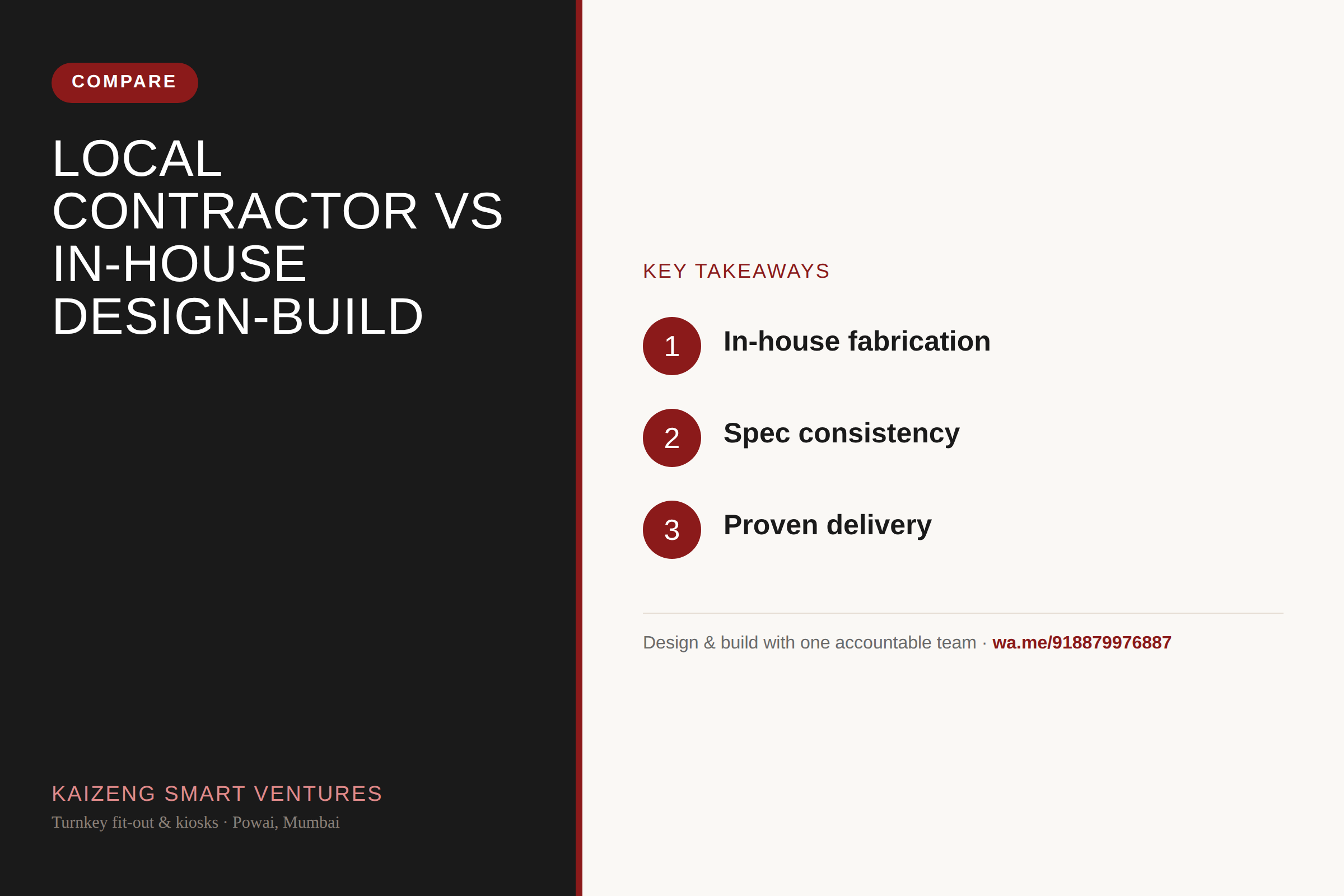
The difference is who actually builds your space: a local contractor usually designs and then outsources fabrication to a workshop it does not own, while an in-house design-and-build firm employs the people who cut, laminate and install. That one split changes the speed of changes, the quality control and the consistency you get on site.
Most fit-out firms describe themselves as contractors, but they do not all work the same way. The biggest split is between a firm that designs and then outsources the actual fabrication to a workshop it does not own, and a firm that designs and builds in-house. It sounds like a technicality. On your site, it changes the result.
How does the outsourced contractor model work?
A lot of local contractors and design studios operate as coordinators. They win the project, produce the design, and then hand fabrication to a carpenter or workshop across town. The work can still be good, but every instruction passes through a relay: you to the contractor, the contractor to a workshop that has never met you or your deadline. When a finish comes back wrong, the fix has to travel the same relay back, which is why small changes can take days.
How does the in-house design-and-build model work?
An in-house design-and-build firm employs the people who cut, laminate and install your space. The person who draws it is connected directly to the person who builds it. A change goes straight to the floor. Quality is checked on the firm's own premises before anything reaches your site, rather than discovered when it is delivered.
How do the two models compare?
Speed of changes: in-house is faster because there is no relay, while outsourced adds a coordination layer to every adjustment. Quality control: in-house checks the build on its own floor, while outsourced relies on a workshop's standards you cannot see. Consistency across outlets: in-house builds every unit the same way, which matters for a brand rolling out multiple sites, while outsourced can mean a different workshop and a different result per project. Local knowledge: a genuinely local contractor may know a specific municipal process or building better, though a good in-house firm plans that compliance in regardless.
| Factor | Outsourced contractor | In-house design-and-build |
|---|---|---|
| Speed of changes | Adds a coordination layer to every adjustment, so small changes can take days | Faster because there is no relay, a change goes straight to the floor |
| Quality control | Relies on a workshop's standards you cannot see | Checks the build on its own floor before anything reaches your site |
| Consistency across outlets | Can mean a different workshop and a different result per project | Builds every unit the same way |
| Local knowledge | A genuinely local contractor may know a specific municipal process or building better | A good in-house firm plans that compliance in regardless |
When is a local contractor the right call?
If your job is small, standard, and you have a local contractor you already trust who does solid work, that relationship has real value and there is no need to over-engineer the decision. The in-house advantage compounds as the build gets more complex, the finish bar gets higher, or you plan to repeat the format across locations.
How does Kaizeng fit?
Kaizeng designs and fabricates in its own 6000+ sq ft unit in Powai, Mumbai, and installs with its own team. There is no relay to a workshop we do not control. That is what let us take Penguin Bean Coffee in Bandra from a bare shell to a working cafe in 18 days, and it is why brands rolling out multiple outlets get the same unit built the same way every time.
See our fit-out service, Discuss Your Project, or message us on WhatsApp.
