
Ambience Lessons From Mumbai's Cafes
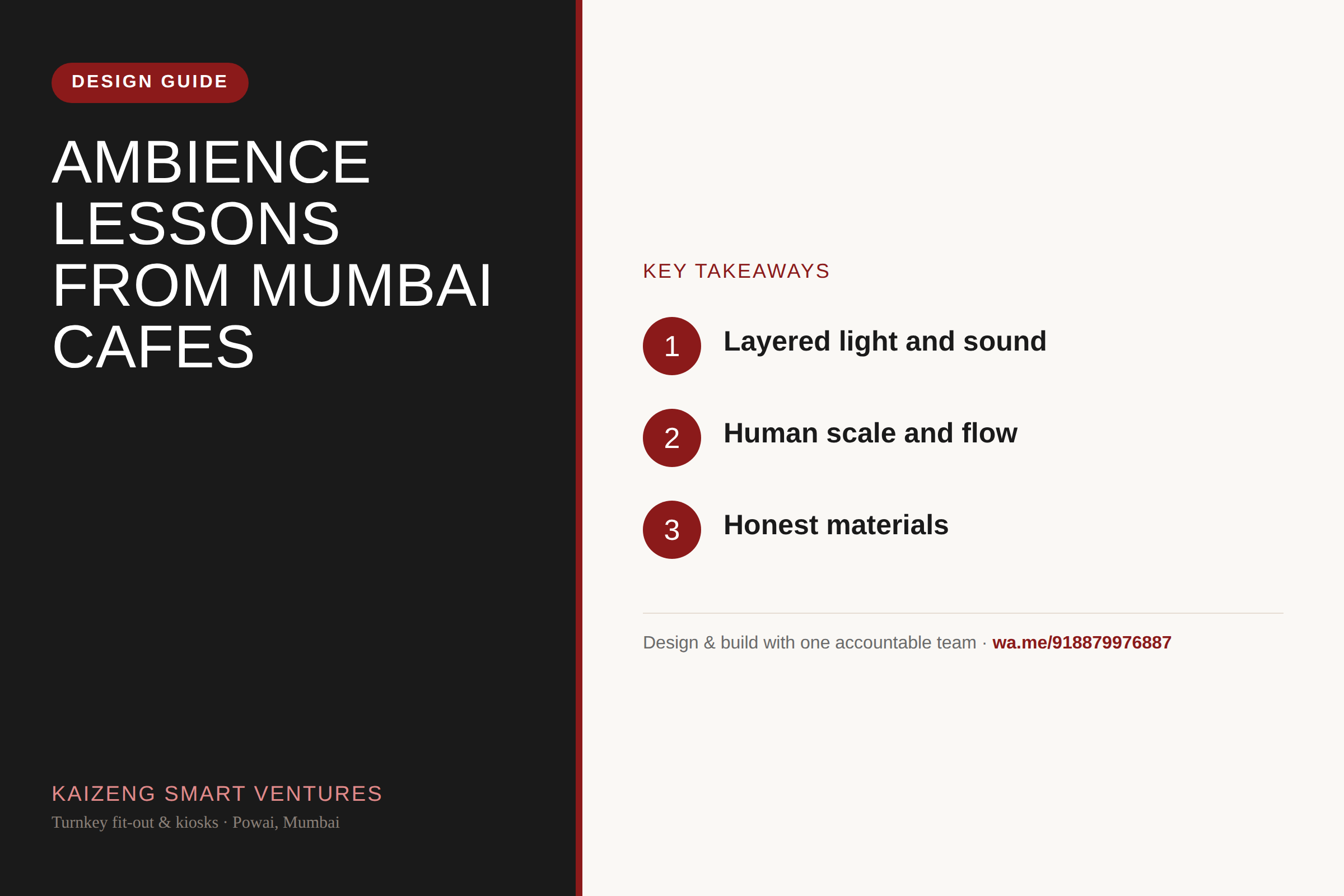
A Mumbai cafe feels loved when it gets a handful of design fundamentals right, layered light, managed sound, human scale, easy flow, honest materials and overall consistency, whatever its style or budget. These principles cost thought more than money, and they separate a room people pass through from a room people adopt as their own.
Mumbai has a deep and varied cafe culture, from old Irani establishments with high ceilings and marble tables to compact speciality coffee bars tucked into busy lanes. Spend enough time in them and patterns emerge. The spaces people genuinely love, the ones they return to week after week, tend to get the same handful of things right, whatever their style or budget. This guide is not a ranking of venues. It is a look at the design principles that repeatedly separate a room people pass through from a room people adopt as their own.
| Ambience lesson | Design principle |
|---|---|
| Light | Layer daylight, a warm counter glow and softer pools over tables; uniform light feels institutional, layered light feels human |
| Sound | Manage acoustics with volume, soft furnishings and absorption; hard reflective surfaces exhaust guests |
| Human scale | Break the space into human sized zones so every kind of guest has a place made for them |
| Flow | Make ordering, sitting and leaving obvious so the path never needs thinking about |
| Materials | Use honest materials with character that age well and survive the monsoon |
| Consistency | Point light, sound, scale, materials and service the same way for one clear personality |
Why does light matter most?
Walk into any beloved cafe and notice how it is lit. The memorable ones almost never rely on flat, uniform ceiling light. They layer it, some daylight from a window, a warm glow at the counter, softer pools over the tables. That variation gives the room depth and tells your eye where to rest. Older Mumbai cafes often got this for free through tall windows and big openings. Newer ones achieve it deliberately with multiple warm sources at different heights. The lesson is simple. Uniform light feels institutional, layered light feels human.
How is a cafe's sound designed?
A cafe that feels comfortable to talk in has usually managed its acoustics, whether the owner knows it or not. The classic high ceilinged rooms use their volume and soft furnishings to keep chatter from becoming a roar. Smaller modern spaces that feel calm have absorption built in, upholstered seats, timber, textiles. The cafes that exhaust you are the ones with every surface hard and reflective. You do not consciously notice good acoustics, but you feel them as ease. That is why sound deserves attention long before opening day.
Why does human scale beat grand gestures?
The rooms people love rarely feel like a showroom. They break a space into human sized zones, a window seat for one, a corner for a pair, a communal table for a group. This gives every kind of guest a place that feels made for them. Even large heritage cafes achieve intimacy by the way tables and partitions carve the volume. The takeaway for any new cafe is to design for the individual moment, not just the wide photograph. Comfort at the scale of one table is what brings people back.
What does good flow feel like?
In a well designed cafe you never wonder where to order, where to sit or how to leave. The path is obvious. Counters sit where they naturally draw a queue without blocking the room, seating is reachable without squeezing, and staff move without colliding with guests. Bad flow creates friction you feel as vague discomfort. Good flow is invisible. This is planning work, and it is central to how we approach every project in the cafe and coffee segment, because a room that works operationally is a room that feels calm to be in.
Which materials tell an honest story?
Loved cafes tend to use materials with character and honesty, warm timber, aged metal, stone, textiles, rather than a thin veneer of trend. These materials also age well, gaining patina instead of looking tired. In Mumbai's humid climate the honest choices are often the practical ones too, since durable, breathable, well treated materials survive the monsoon. A room built from genuine materials feels grounded, and that groundedness reads as authenticity to the people sitting in it.
Why does consistency earn loyalty?
The final lesson is that a loved cafe feels coherent. Light, sound, scale, materials and service all point the same way, so the space has one clear personality rather than a collection of ideas. That consistency is what turns a first visit into a habit. It comes from deciding what the room is meant to feel like, then holding every decision to that intent. For owners planning their own space, our Mumbai cafe interior design page and our guide on cafe interior design in Mumbai go deeper on turning intent into a finished room.
Common questions
What single thing most affects how a cafe feels? Lighting, closely followed by acoustics. Both work below conscious attention, so guests rarely name them, but they shape comfort more than any decorative feature.
Do heritage cafes and modern cafes follow the same principles? Yes. The styles differ, but the underlying rules, layered light, managed sound, human scale, easy flow and honest materials, are shared by loved rooms across both.
Can a small budget still create great ambience? Absolutely. The principles here cost thought more than money. Good planning of light, sound and flow can make a modest room feel far better than an expensive but incoherent one.
Design a room people adopt as their own
The cafes Mumbai loves are not lucky, they are considered. Kaizeng Smart Ventures brings these principles into every build, planning light, sound, scale and flow together and executing from bare shell with one accountable team. See how we work on our services overview or message us on WhatsApp to start the conversation.
